Skip to content

Computational IntelligenceUniversity of Oldenburg

Oliver Kramer

I develop computational intelligence methods that connect optimization, learning, cognition, and biological data.

My work investigates how adaptive systems search, learn, reason, and extract structure from complex data.

Position
Prof. Dr. Professor of Computational Intelligence
Institution
University of Oldenburg
Focus
Optimization · Learning · Cognition
x₁x₂f(x) ↓01 EVOLUTION STRATEGIES02 MACHINE & DEEP LEARNING03 AI & COGNITION04 AI & BIOINFORMATICS
FIG. 01 — METHOD EXCHANGE GRAPHn = 4 · e = 5

HOVER A NODE TO INSPECT A DIVISION

01 / Research Divisions

Four perspectives on computational intelligence

The lab studies intelligent systems across optimization, learning, cognition, and biological discovery. These divisions are distinct, but designed to exchange methods and ideas.

  • 01

    Evolution Strategies

    Developing robust methods for black-box optimization, self-adaptation, and search in complex, high-dimensional spaces.

    • Evolutionary computation
    • CMA-ES
    • Black-box optimization
    • Multi-objective search
  • 02

    Machine & Deep Learning

    Designing learning systems that discover useful representations, generalize reliably, and remain interpretable under real-world conditions.

    • Deep neural networks
    • Lipschitz attacks
    • Neural architecture search
  • 03

    AI & Cognition

    Studying computational models of reasoning, learning, decision-making, and the relationship between artificial and human intelligence.

    • Cognitive prompting
    • Reasoning
    • AGI
  • 04

    AI & Bioinformatics

    Applying machine intelligence to biological data to uncover patterns, generate hypotheses, and support scientific discovery.

    • Molecule design
    • Omics
    • Protein pockets

02 / Selected Systems

Research ideas, made executable

01 / ADVERSARIAL CRITIQUE · LLM PIPELINE · STATISTICS AUDIT

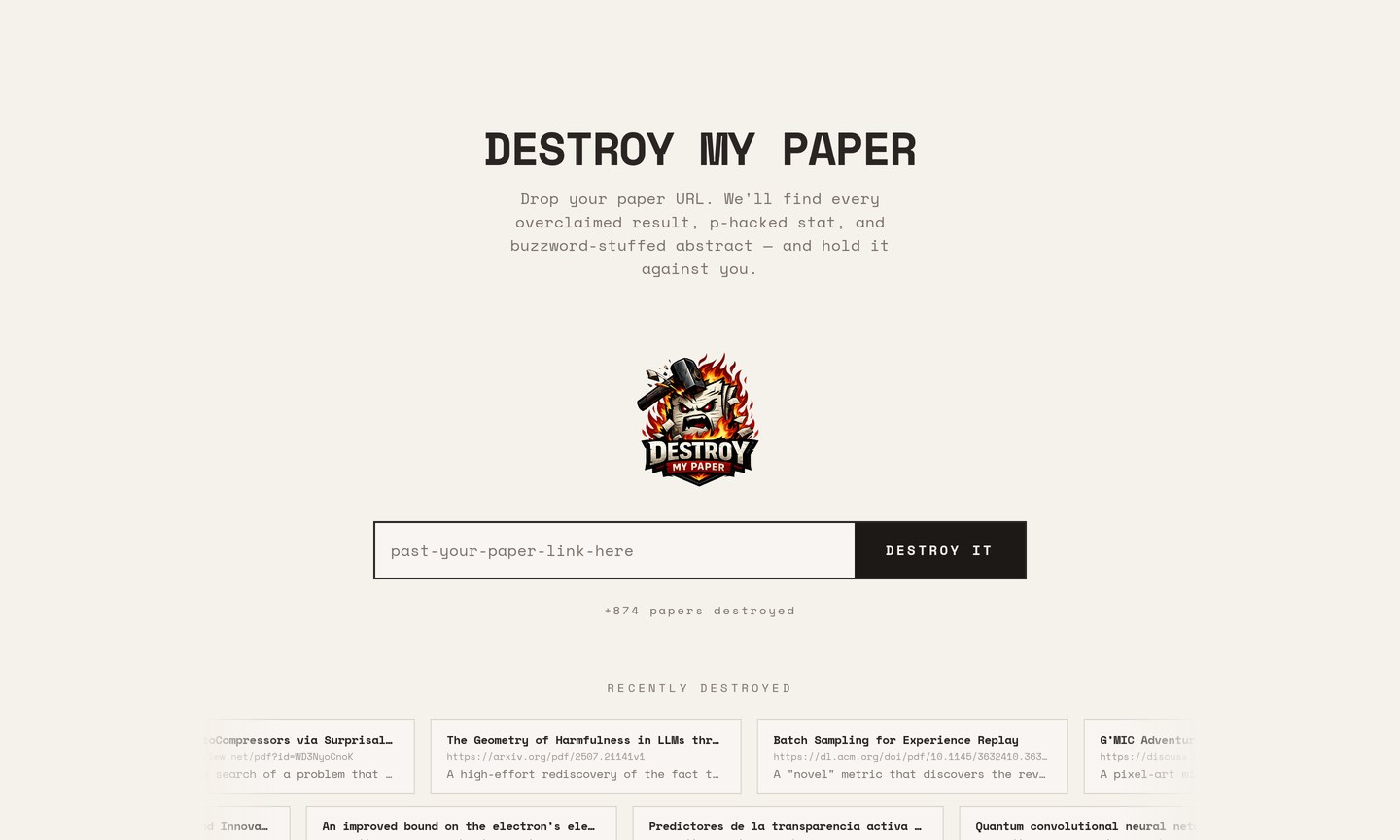
Destroy My Paper

An adversarial AI critic that stress-tests research papers—surfacing overclaims, questionable statistics, methodological weaknesses, and buzzword-heavy writing.

PEER REVIEW, WITH THE POLITENESS FILTER REMOVED.

Destroy a paper destroymypaper.com
Screenshot of the Destroy My Paper interface
FIG. 01ADVERSARIAL REVIEW INTERFACELIVE SYSTEM

02 / PARALLEL TRANSLATION · IDIOM NOTES · 99 LANGUAGES

LangDash

A world dashboard for translation: one phrase rendered simultaneously across the eight most spoken languages, with notes on idioms and grammar — plus a Europe view and a 99-language mode.

ONE PHRASE, 99 LANGUAGES, SIDE BY SIDE.

Open LangDash langdash.net
Screenshot of the LangDash interface
FIG. 02MULTILINGUAL DASHBOARDLIVE SYSTEM

03 / NUMPY FROM SCRATCH · (1+1)-ES · SVM · MLP · CNN

An Introduction to Machine Learning with Evolution Strategies

A hands-on course that implements ML algorithms from scratch in NumPy — SVM, MLP, clustering, and CNNs — and trains every model with the same derivative-free optimizer: the (1+1)-Evolution Strategy.

EVERY MODEL, ONE OPTIMIZER, NO BLACK BOXES.

Open in Colab colab.research.google.com/drive/1OG85vWVaMF6AEA6evhZvmKXZihMGE3ml?usp=sharing
Screenshot of the An Introduction to Machine Learning with Evolution Strategies interface
FIG. 03SVM · OPTIMIZATION · REGRESSION — (1+1)-ESLIVE SYSTEM

03 / Publications

Selected work

  1. 2026LMAP: Local PCA Models with Global MDS EmbeddingsO. KramerESANN 2026Machine & Deep Learning · c140LINK
  2. 2026Linear Evaluation Complexity of Surrogate-Assisted (1+1)-EA on OneMaxO. KramerESANN 2026Evolution Strategies · c139LINK
  3. 2026Adaptive Search in Collatz Exponent-Code Space via 2-adic and 3-adic ConstraintsO. KramerCoRR abs/2607.10041Evolution Strategies · i20LINK
  4. 2025Unlocking Structured Thinking in Language Models with Cognitive PromptingO. Kramer, J. BaumannESANN 2025AI & Cognition · c138LINK
  5. 2025An LLM-Based Multi-Agent Framework for Evolutionary Blackbox OptimizationJ. Baumann, O. KramerGECCO Companion 2025: 671–674Evolution Strategies · c137LINK
  6. 2025Enhancing Evolutionary Algorithms Through Meta-Evolution StrategiesO. KramerIEEE CAI 2025: 1292–1297Evolution Strategies · c136LINK
  7. 2025Evolutionary Cognitive Prompting for Enhancing the Capabilities of Language ModelsO. KramerIEEE CAI 2025: 1298–1301AI & Cognition · c135LINK
  8. 2025Sequence-Based Protein Pocket Prediction via ProtT5 Embeddings and Spatial SamplingR. Rebollido-Rios, O. KramerIEEE CAI 2025: 1312–1315AI & Bioinformatics · c134LINK
  9. 2025Conceptual Metaphor Theory as a Prompting Paradigm for Large Language ModelsO. KramerCoRR abs/2502.01901AI & Cognition · i19LINK
  10. 2025Cognitive Prompts Using Guilford's Structure of Intellect ModelO. KramerCoRR abs/2503.22036AI & Cognition · i18LINK
  11. 2025Cognitive BASIC: An In-Model Interpreted Reasoning Language for LLMsO. KramerCoRR abs/2511.16837AI & Cognition · i17LINK
  12. 2024LLaMA Tunes CMA-ESO. KramerESANN 2024Evolution Strategies · c133LINK
  13. 2024Towards Explainable Evolution Strategies with Large Language ModelsJ. Baumann, O. KramerESANN 2024Evolution Strategies · c132LINK
  14. 2024Evolutionary Multi-objective Optimization of Large Language Model Prompts for Balancing SentimentsJ. Baumann, O. KramerEvoApplications @ EvoStar 2024: 212–224Machine & Deep Learning · c131LINK
  15. 2024Evolutionary Multi-Objective Optimization of Large Language Model Prompts for Balancing SentimentsJ. Baumann, O. KramerCoRR abs/2401.09862Machine & Deep Learning · i16LINK
  16. 2024Large Language Models for Tuning Evolution StrategiesO. KramerCoRR abs/2405.10999Evolution Strategies · i15LINK
  17. 2024Towards Explainable Evolution Strategies with Large Language ModelsJ. Baumann, O. KramerCoRR abs/2407.08331Evolution Strategies · i14LINK
  18. 2024Unlocking Structured Thinking in Language Models with Cognitive PromptingO. Kramer, J. BaumannCoRR abs/2410.02953AI & Cognition · i13LINK

06 / Art & Music

Generative side channel

Experiments in AI-generated imagery and sound released under the alias ACIDBOT — the same generative machinery as the research, tuned for aesthetics instead of benchmarks.

Snakefire — AI-generated artwork by ACIDBOT

FIG. A1ACIDBOTVIDEO

Snakefire

AI-generated cover art · music video

An ouroboros of fire as cover art for a generative track: the loop that consumes and regenerates itself — the same feedback motif that drives an evolution strategy, rendered in sound and image.

Watch on YouTube
Quantum — AI-generated artwork by ACIDBOT

FIG. A2ACIDBOTVIDEO

Quantum

AI-generated music video

A saturated post-urban landscape overgrown by branching structures — diffusion models pushed until the colour space itself becomes the subject. Visuals sequenced to an electronic score.

Watch on YouTube

07 / About

Biography

Portrait photograph of Oliver Kramer
FIG. 02 — SUBJECTOK

Oliver Kramer is Professor of Computational Intelligence at University of Oldenburg, working at the intersection of evolutionary computation, machine learning, cognition, and bioinformatics.

He develops computational methods for understanding and building adaptive intelligent systems — from self-adaptive search in high-dimensional spaces to interpretable learning models and computational accounts of reasoning. His group teaches and supervises across the Department of Computing Science, and collaborates with partners in the natural and life sciences.

Location
Oldenburg, Germany
Research group
Computational Intelligence Lab
Google Scholar
Profile

08 / Press

Public relations

Selected media coverage and public conversations on artificial intelligence, cognition, and the future of intelligent machines.

DER SPIEGEL — Podcast »Moreno+1« cover art

FIG. P1DER SPIEGELPodcast »Moreno+1«

»Eine starke KI? Halte ich für wahrscheinlich«

KI-Professor Oliver Kramer beschäftigt sich mit Algorithmen, »die menschenähnliche kognitive Leistungen vollbringen«. Für ihn steht fest: Maschinen werden intelligenter als Menschen sein. Wir sollten darüber nachdenken.
Read on DER SPIEGEL

09 / Contact

Let's work on difficult problems.

I welcome research collaborations, interdisciplinary projects, doctoral inquiries, and conversations about computational intelligence.